AhsayCBS Exploit Drops PNG Steganography Webshells and XMRig Miner
Huntress found that attackers who broke into AhsayCBS backup servers through CVE-2026-105133 and CVE-2026-105134 left five webshell families, including a PNG steganography loader, an XMRig miner, a host-bound Python implant and signs of Veeam credential theft.
Threat card
- Status
- Actively exploited
- Threat type
- Threat Intelligence
- Disclosed
- Oct 8, 2026
- Affected
- AhsayCBS v10 before 10.3.4.45 and v7 to v9 before 9.15.2.70
The short version
- Attackers exploited AhsayCBS CVE-2026-105133 and CVE-2026-105134 between 8 and 11 October 2026, before hotfixes existed.
- Huntress found five webshell families, including a loader that hides AES-encrypted payloads in PNG pixel bits.
- The intruders added an XMRig miner, a host-bound Python implant, tunnels, remote access tools and Defender exclusions.
- A related Veeam server showed signs of stored backup credentials being decrypted with DPAPI.
An AhsayCBS exploit chain gave attackers SYSTEM-level access to internet-exposed backup servers between 8 and 11 October 2026, before Ahsay shipped hotfixes, and Huntress has now published what they left behind. Its 9 November follow-up documents five webshell families, one hiding encrypted payloads inside PNG pixels, a second XMRig miner, a host-bound Python implant and a credential grab against a neighbouring Veeam server. The flaws are CVE-2026-105133 and CVE-2026-105134. Patching closes the door but removes nothing already inside, so every AhsayCBS server exposed before patching needs a hunt.
What happened
Attackers chained an AhsayCBS authentication bypass (CVE-2026-105133) with an unauthenticated SYSTEM-level remote code execution flaw (CVE-2026-105134) to plant webshells on exposed backup servers. They then added a cryptominer, tunnels, remote access tools and a stealthy Python implant, and reached into Veeam backup credentials.
Huntress first reported the campaign in early October 2026, when it saw the flaws used to drop webshells and an XMRig miner. The Huntress AhsayCBS webshell follow-up by Jonathan Semon covers three servers breached between 8 and 11 October, before Ahsay released fixes. Huntress tied the servers to the earlier campaign through webshell placement in AhsayCBS web directories, an exploit source address from its first post, and matching files. It could not confirm what every payload did or whether backup data was stolen.
Timeline
| Date (2026) | Event |
|---|---|
| Early October | Huntress observes exploitation of AhsayCBS flaws to drop webshells and an XMRig miner. |
| 8 October | Huntress publishes its first report on the campaign. |
| 8 to 11 October | The three servers in the follow-up are compromised, before vendor hotfixes exist. |
| After 8 October | Ahsay releases hotfix 10.3.4.45 (v10) and 9.15.2.70 (v7 to v9). Huntress verifies 10.3.4.45 blocks the observed entry point. |
| 9 November | Huntress publishes the follow-up with full tooling analysis and IOCs. |
How the attack works
Initial access
The attackers exploited internet-facing AhsayCBS with CVE-2026-105133, an authentication bypass, and CVE-2026-105134, an unauthenticated remote code execution as SYSTEM reached through /rps/api/json/UpdateReceivers.do. CVSS scores were not given in the Huntress post.
Persistence through webshells
Huntress found five webshell families under webapps\cbs and webapps\rps. Keyed command shells such as a2b59a4bb296604b.jsp answer a wrong key with a 404 and return Base64 output from cmd.exe /c; one variant also writes files. The status_*.jsp shells add recursive delete and self-delete, while the st_*.jsp variant drops authentication altogether. Copies also sat under Linux-style folders such as C:\opt, C:\usr and C:\home, plus a staging folder C:\ahsay_tf.
The PNG steganography loader (AhsayCBS.jsp)
AhsayCBS.jsp poses as an image preview service. The operator posts a PNG, and the page rebuilds a payload from the least significant bit of each red, green and blue value: a 4-byte length followed by data decrypted with Java’s default AES mode (ECB, PKCS5) and a hardcoded key. The first request loads the decrypted class through a custom ClassLoader and stores it in the application context under QuCh; later requests invoke it and hide the output in a fresh PNG. Network traffic therefore looks like image uploads and image responses. Huntress analysed the loader but not the class it received.
The signed API shell (nsmind.jsp)
nsmind.jsp demands an X-Auth-Token, an X-Timestamp within five minutes, a single-use X-Nonce and an HMAC-SHA256 X-Signature. It offers exec, cd, upload and download, with chunked transfers up to 4 GB per file. Huntress calls the download function a ready-made exfiltration channel, though no logs confirmed its use.
Impact: cryptomining
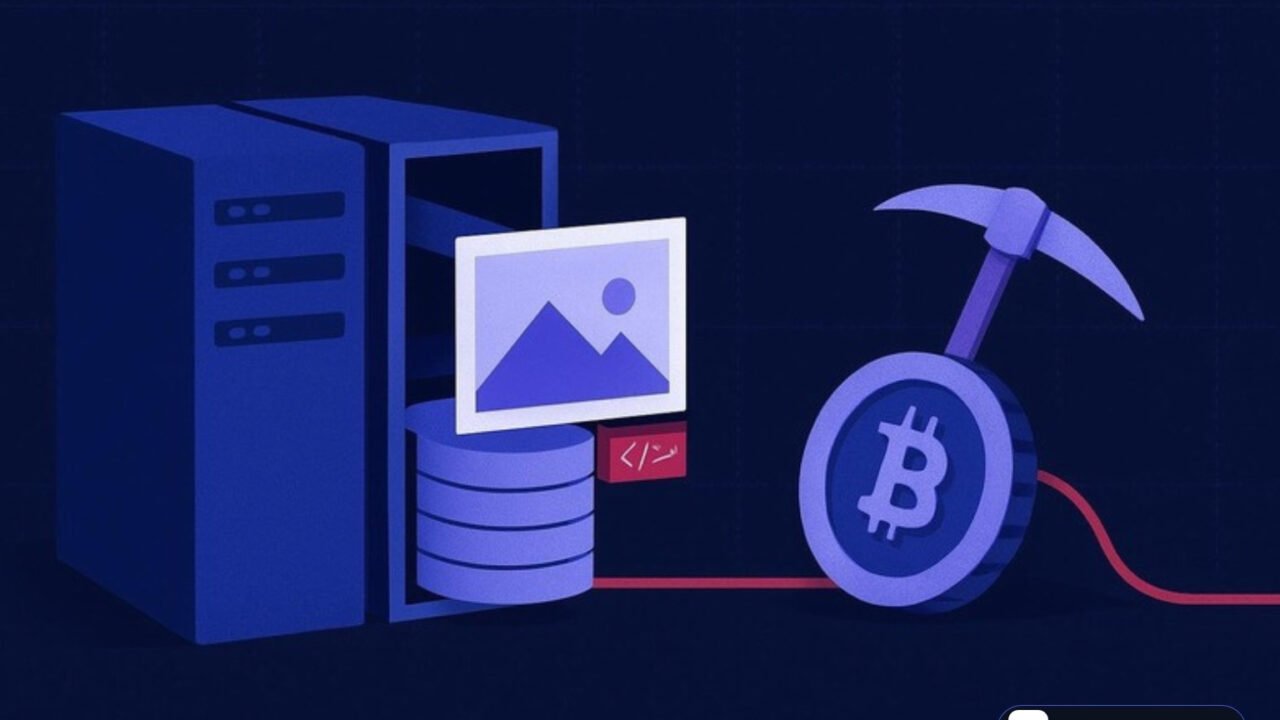
A second XMRig build, kvm-agent.exe in C:\Windows\SysWOW64\kvm-agent\, mined to SupportXMR pools over TLS on port 443. A SYSTEM scheduled task named kvm checked every minute with tasklist and restarted it; its start time was backdated.
The host-bound Python implant
main.py ran from an embedded Python distribution under the SYSTEM profile, launched by a Run key through explorer.exe. It hashes the host MachineGuid with SHA-256 and exits unless a marker file with that name exists, which keeps it from running in a sandbox. It then copies a 673 KB blob into executable heap memory and reflectively loads an x64 C++ DLL whose strings include a C2 URL and DNS-over-HTTPS fragments for Quad9 and Google. The family is unidentified.
Defence evasion, tunnelling and credential access
The operators added Microsoft Defender exclusions for C:\ProgramData, C:\Windows, temp folders and the AhsayCBS service cbssvcX64.exe, created a local account wdguest, staged gost and chisel tunnels, and installed AnyDesk, Atera and Splashtop. A Mimikatz package sat on disk. On a related Veeam server, a PowerShell command consistent with NetExec’s Veeam module queried the VeeamBackup PostgreSQL database and decrypted stored credentials with DPAPI.
MITRE ATT&CK mapping
| Tactic | Technique (ID) | How it was used here |
|---|---|---|
| Initial Access | Exploit Public-Facing Application (T1190) | CVE-2026-105133 and CVE-2026-105134 on exposed AhsayCBS. |
| Execution | Windows Command Shell (T1059.003) | Webshells run commands through cmd.exe /c. |
| Execution | Python (T1059.006) | Embedded Python runs main.py. |
| Persistence | Web Shell (T1505.003) | Five JSP webshell families in AhsayCBS web directories. |
| Persistence | Scheduled Task (T1053.005) | Task kvm restarts the miner every minute. |
| Persistence | Registry Run Keys (T1547.001) | Run key launches the Python implant. |
| Defense Evasion | Steganography (T1027.003) | Payloads and output hidden in PNG pixel bits. |
| Defense Evasion | Disable or Modify Tools (T1562.001) | Broad Defender exclusions. |
| Defense Evasion | Reflective Code Loading (T1620) | DLL mapped from memory by the Python implant. |
| Defense Evasion | Environmental Keying (T1480.001) | Implant runs only where the MachineGuid marker exists. |
| Credential Access | Credentials from Password Stores (T1555) | Veeam stored credentials decrypted with DPAPI. |
| Command and Control | Protocol Tunneling (T1572) | gost and chisel. |
| Command and Control | Remote Access Software (T1219) | AnyDesk, Atera and Splashtop. |
| Impact | Compute Hijacking (T1496.001) | XMRig mining to SupportXMR. |
Who is behind it
Not yet attributed. Huntress names no threat actor and could not identify the implant family. It links the activity to its October campaign through webshell placement, a shared exploit source address and matching files, and notes that byte-identical shells and a miner task created the same night on two servers suggest one operator or script. Huntress assesses the operator was deliberately interested in backup infrastructure.
Affected products and versions
| Product | Affected | Fixed | CVE | CVSS |
|---|---|---|---|---|
| AhsayCBS v10 | Before 10.3.4.45 | 10.3.4.45 | CVE-2026-105133, CVE-2026-105134 | Not given |
| AhsayCBS v7 to v9 | Before 9.15.2.70 | 9.15.2.70 | CVE-2026-105133, CVE-2026-105134 | Not given |
Indicators of compromise
| Type | Indicator (defanged) | Context |
|---|---|---|
| Domain | hxxps://creepexplosiondarknight[.]com/d |
Python implant C2 |
| Domain | pool.supportxmr[.]com:443, pool-fr.supportxmr[.]com:443 |
Mining pools |
| IP | 104.243.43[.]115:443 |
Mining pool |
| SHA-256 | 8245c7e7d944923f1608592f6c3473dcc6e3a3e43df3dd1c6257e7880948787b |
kvm-agent.exe (XMRig) |
| SHA-256 | 6c7a4061bcf08df5fe4a49d37442dc650d751be1a91a8bc802edff213e4d5e61 |
AhsayCBS.jsp PNG loader |
| SHA-256 | 6c695baad1d81ed49194d07a79381292c0466208ff1a9862c0c55f971d6a409f |
nsmind.jsp signed shell |
| SHA-256 | e6e576a634166a16bdbfc09b14e7cf8eab90015d2dfa67dd73f3968ee869229b |
a2b59a4bb296604b.jsp keyed shell |
| SHA-256 | 8aac187bae71f75fa2dde03dcb4a9279c982182ee8254ae96e7a6626fe4c7617 |
main.py Python loader |
| SHA-256 | bb2472cf5dc7e5c94216d355bf84fba2c8d088d03d61a1ac0d78639049cf5e1f |
Reflectively loaded x64 DLL |
| SHA-256 | 6f6b66cbdc4a5aa5685d0017abd3f65843a28bcc2bb4e5b78d6d12a844a51aa8 |
gost |
| SHA-256 | ca5f8e5247f1a044b8be45ef03187726b9af3ac30fd93fb5bb54144e34ed3738 |
chisel |
| Path | C:\Windows\SysWOW64\kvm-agent\ |
Miner directory |
| Task / account | kvm / wdguest |
SYSTEM scheduled task / rogue local account |
| Folders | ahsay_poc_*, ahsay_tf, ahsay_th, ahsay_t0 |
Staging artifacts |
The Huntress report also lists the webshell keys, HMAC secrets and the miner wallet for matching against your own logs.
Detection and hunting
- Search AhsayCBS access logs for requests to
UpdateReceivers.do, and thewebapps\cbsandwebapps\rpsfolders for unexpected.jspfiles, especiallystatus_andst_names. - Alert when
cbssvcX64.exespawns a command shell, and when new.jspfiles are written under AhsayCBS web directories. - Look for
python.exeorpythonw.exerunning from a SYSTEM profile path, and for Run keys pointing at it. - Flag non-browser processes contacting public DNS-over-HTTPS resolvers.
- List SYSTEM scheduled tasks with a one-minute repeat that call
tasklist, and Defender exclusions nobody approved. - On Veeam servers, look for PowerShell launched through WMI that queries the
VeeamBackupdatabase.
Mitigation and response
- Install hotfix 10.3.4.45 on AhsayCBS v10 or 9.15.2.70 on v7 to v9.
- Hunt every server that was internet-exposed before patching, since the hotfix does not remove webshells, tasks, accounts or implants.
- If you find compromise, re-image from a trusted backup rather than cleaning in place.
- Rotate every credential stored on or reachable from the server, including those saved in AhsayCBS and in Veeam or other backup software on the same network.
- Remove unauthorized Defender exclusions, the
wdguestaccount and unapproved AnyDesk, Atera and Splashtop installs. - Keep backup management consoles off the internet and monitor them as tier-zero assets.
Analyst take
The miner is the noisy part; the tradecraft around it is not. A PNG steganography loader, replay-protected signed shells and a host-keyed implant are the habits of an operator planning to keep access, not a smash-and-grab crypto crew. Pairing that with a deliberate reach into Veeam credentials says backup infrastructure is the objective, and backup servers are exactly where ransomware crews go to disable recovery. The Beget wiper attack that erased backups shows how that ends.
MSPs and hosting providers running multi-tenant AhsayCBS should worry most, because one server holds many customers’ data and credentials. Treat this like the N-able N-central exposure: patch, hunt, and assume any credential the box could reach is burned until proven otherwise.
What to do now
0 of 5 done
Questions readers ask
Which AhsayCBS vulnerabilities are being exploited?
CVE-2026-105133, an authentication bypass, and CVE-2026-105134, an unauthenticated remote code execution as SYSTEM via UpdateReceivers.do.
Does the AhsayCBS hotfix remove the webshells?
No. Hotfixes 10.3.4.45 and 9.15.2.70 block the entry point, but existing webshells, tasks and implants must be found and removed or the server re-imaged.
How did the attackers hide their payloads?
One webshell rebuilt AES-encrypted Java classes from the least significant bits of PNG pixels and returned its output inside another PNG.
Sources
- Huntress: AhsayCBS intrusion follow-uphuntress.com
- Cyber Security News: Hackers Exploit AhsayCBS Vulnerabilities to Hide Malware in PNG Imagescybersecuritynews.com
One short email when something serious breaks.
Threatspedia covers major cyber threats only, verified against primary sources. Read our editorial policy, or report a correction.