FBI ARTEX Warning: AI Hacking Tool Chains Intrusions in Under 3 Hours
The FBI says multiple threat actors have used ARTEX, an open-source LLM-driven penetration testing framework, since August 2026 to automate intrusions across ten sectors, with some reaching privileged access in under three hours. Its FLASH alert lists TTPs, IOCs and hunting guidance.
Threat card
- Threat type
- AI Security
- Disclosed
- Nov 13, 2026
- Affected
- Internet-facing apps, Microsoft 365 and Entra tenants, AWS and Azure workloads, Active Directory; ConnectWise Cloud Backup customers
The short version
- The FBI says multiple threat actors have weaponised the ARTEX autonomous penetration testing framework since at least August 2026.
- ARTEX plugs into external LLMs such as Claude, GPT, DeepSeek, GLM, Grok and Kimi, and some intrusions reached privileged access in under three hours.
- The FLASH alert ties ARTEX to the ConnectWise Cloud Backup supply chain compromise, attacks on South Korean banks and Storm-3358 infrastructure.
- Removing the GitHub repository on 8 October did not stop it: forks, archives and a paid ARTEX PRO edition still circulate, with over 1,600 exposed consoles seen.
The FBI has issued a FLASH alert warning that multiple threat actors are using ARTEX, an open-source, LLM-driven autonomous penetration testing framework, to automate intrusions against organisations worldwide. In this FBI ARTEX warning, dated 13 November 2026, the bureau says abuse began in at least August 2026 and that some intrusions moved from first targeting to privileged access in under three hours. Defenders should review internet-facing applications, Microsoft 365 tenants and cloud logs now, and hunt for the behaviours and indicators the alert lists.
What happened
On 13 November 2026 the FBI published FLASH-20261113-001, a TLP:CLEAR threat overview of the ARTEX framework. It says ARTEX lets actors with minimal skill run complex, multi-target operations at once, and links it to the ConnectWise Cloud Backup supply chain compromise and attacks on South Korean banks.
ARTEX is written in Go. It converts natural-language tactical goals into machine commands that specialised AI agents carry out. It has no model of its own and instead calls external providers. The FBI names Anthropic Claude, OpenAI GPT, DeepSeek, GLM, Grok and Kimi, and says Chinese-origin models dominate attacker instances, with DeepSeek Flash-family models the most common.
A developer known as Autumn-27 released ARTEX on GitHub in July 2026 and removed the repository on 8 October 2026. According to BleepingComputer’s report on the alert, forks, archived copies, localised versions and a commercial ARTEX PRO edition remain available, and researchers had found more than 1,600 publicly exposed ARTEX consoles by early November. Threatspedia covered an earlier ARTEX incident in our report on the WorkOS breach by an escaped ARTEX agent.
Timeline
| Date | Event |
|---|---|
| July 2026 | Autumn-27 releases ARTEX on GitHub |
| August 2026 | Earliest malicious use observed by the FBI |
| 1 October 2026 | Start of the FBI’s recommended review window for ConnectWise-related activity |
| 7 October 2026 | CrowdStrike reports on the South Korean finance campaign |
| 8 October 2026 | Original ARTEX repository removed from GitHub |
| 14 October 2026 | Zscaler ThreatLabz report published |
| 15 to 16 October 2026 | Transient VPN IPs active in Graph API activity through compromised apps |
| 21 to 30 October 2026 | Microsoft, Akamai and Google Threat Intelligence Group reports published |
| 5 November 2026 | Censys, CERT-EU and Check Point reports published |
| 6 November 2026 | Storm-3358 infrastructure active |
| 13 November 2026 | FBI releases FLASH-20261113-001; MalwareMustDie publishes an ARTEX detection pack |
How the attack works
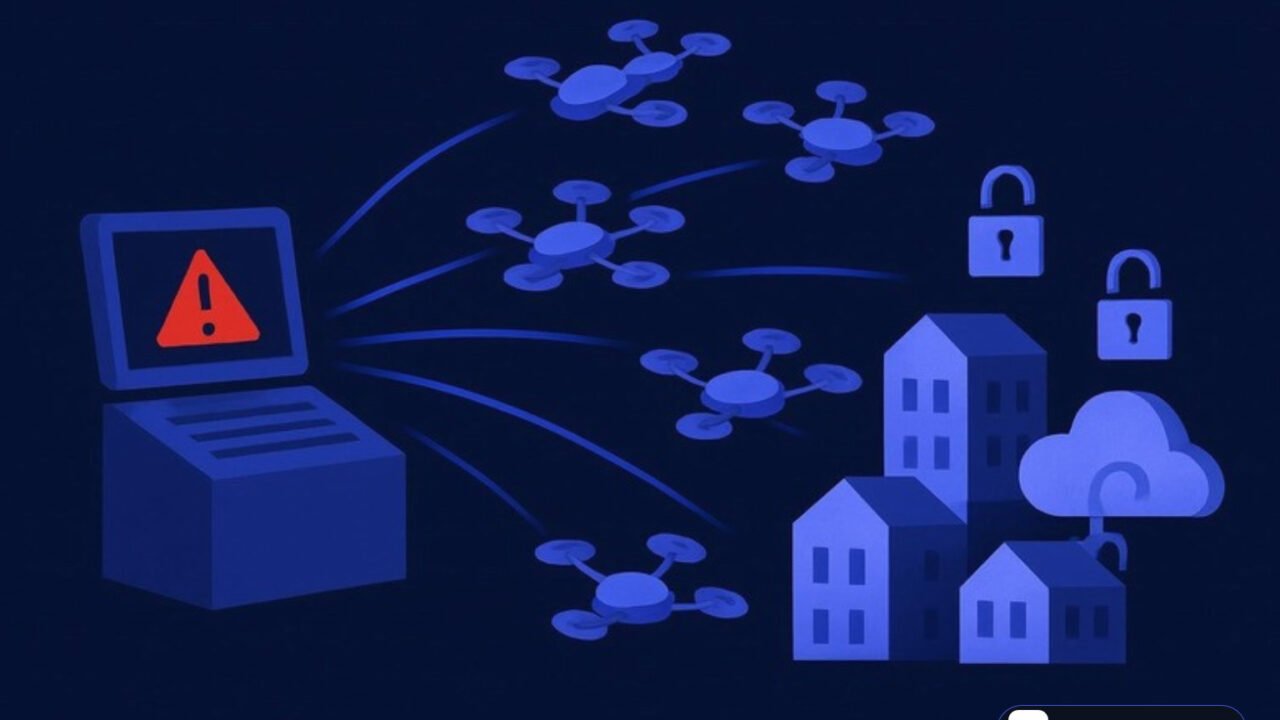
ARTEX does not introduce new exploits. Its danger is speed and scale: the operator states a goal, and agents chain reconnaissance, exploitation, escalation and collection with little human input, retrying different paths when one fails. The FBI says it is especially good at finding weak spots in overlooked systems such as partner portals, employee applications, legacy services and third-party integrations.
Reconnaissance
Agents mapped Azure credential permissions, tested AWS IAM permissions with DryRun flags, fuzzed web directories, ran WHOIS mapping and vulnerability scans, and queried api.db-ip[.]com to geolocate victims.
Initial access
The FBI lists exploitation of SAML, XXE, SSRF, SQL injection, IDOR, server-side template injection, command injection and authentication bypass flaws. Agents also abused anonymous file upload, hardcoded admin passwords found in JavaScript bundles, weak admin credentials, stolen VPN configurations and third-party B2B federation.
Foothold and persistence
Observed persistence included JSP and PHP web shells (one planted through MySQL log poisoning), Kudu API abuse, C2 on internal Windows database servers, open-source RATs (WISP, vshell, AdaptixC2), SSH keys, Elastic IP allocations and new OAuth credentials. The FBI also notes BLOODALCHEMY components talking to C2 domains.
Privilege escalation and internal reconnaissance
Agents used high-privilege cloud instances, Kerberoasting, SQL injection credential dumps, DCSync, resource-based constrained delegation, XXE metadata queries and forged admin tokens. Inside networks they enumerated domain controllers with PowerShell, walked more than 110,000 Active Directory objects, read LAPS passwords and inventoried endpoint sensor coverage.
Lateral movement, collection and C2
Lateral movement used pass-the-ticket, pass-the-hash (blocked by endpoint protection in one case), WinRM, Kerberos relay and LLMNR/NBT-NS poisoning. Collection covered SQL queries, mass blob reads, EC2 boot scripts for harvesting, mailbox reads and output to webhook.site, with exfiltration volumes up to 100 GB. C2 ran over residential proxies, Tor, SOCKS, compromised relays and Chisel and SoftEther tunnels.
MITRE ATT&CK mapping
| Tactic | Technique (ID) | How it was used here |
|---|---|---|
| Reconnaissance | Active Scanning (T1595) | Directory fuzzing and vulnerability scanning of exposed apps |
| Discovery | Cloud Infrastructure Discovery (T1580) | IAM permission tests with DryRun flags, Azure permission mapping |
| Initial Access | Exploit Public-Facing Application (T1190) | SAML, XXE, SSRF, SQLi, SSTI and auth bypass flaws |
| Initial Access | Trusted Relationship (T1199) | Abuse of ConnectWise application identities and B2B federation |
| Persistence | Web Shell (T1505.003) | JSP and PHP web shells, including via MySQL log poisoning |
| Persistence | Additional Cloud Credentials (T1098.001) | OAuth credential additions on compromised apps |
| Credential Access | Kerberoasting (T1558.003) | Service ticket cracking during escalation |
| Lateral Movement | Pass the Ticket (T1550.003) | Kerberos ticket reuse inside Active Directory |
| Collection | Data from Cloud Storage (T1530) | Mass blob reads and bucket harvesting |
| Command and Control | Protocol Tunneling (T1572) | Chisel and SoftEther tunnels |
Who is behind it
ARTEX is a tool, not a single actor. The FBI says multiple threat actors use it. In the ConnectWise Cloud Backup (formerly SkyKick) case, Microsoft attributed the campaign to Storm-0940, which BleepingComputer describes as China-state-aligned. Microsoft says the actor used ARTEX to speed up reconnaissance, password spraying and abuse of cloud application permissions, then tried to authenticate to more than 2,250 downstream Microsoft 365 tenants. Huntress had counted at least 162 compromised tenants.
Other clusters in the alert include a Chinese-speaking actor that paired ARTEX with Claude Code agents against Shinhan Bank, KB Kookmin Bank and Hana Bank, exposing data on about 67,000 people, and Microsoft-tracked Storm-3358 infrastructure. BleepingComputer adds that CrowdStrike linked Chinese espionage group Vapor Panda to ARTEX attacks on more than 200 organisations in 14 countries, and that South Korean police arrested seven suspects tied to ARTEX intrusions at over 90 organisations.
Affected products and versions
No CVE is involved. The exposure is any organisation with reachable weaknesses that agents can chain quickly.
| Exposure | Population affected | Notes |
|---|---|---|
| Internet-facing web apps, portals and APIs | Financial, government, technology, defence, semiconductor, energy, healthcare, manufacturing, telecom and legal sectors | Injection, auth bypass and hardcoded secrets abused |
| Microsoft 365 and Entra ID tenants | More than 2,250 tenants targeted via ConnectWise apps | Service principal sign-ins and Graph API abuse |
| AWS and Azure workloads | Not disclosed | IAM, Kudu, metadata and storage abuse |
| Customer personal data | About 67,000 people at South Korean banks | Names, phone numbers and financial data exfiltrated |
Indicators of compromise
The FBI warns that cloud IPs may have been reassigned, so vet each one before blocking.
| Type | Indicator (defanged) | Context |
|---|---|---|
| IP | 38.244.50[.]120 |
ARTEX host and open directory, South Korea campaign |
| IP | 144.172.64[.]60, 144.172.64[.]99, 144.172.64[.]128 |
ConnectWise campaign sign-ins and Graph API activity |
| IP | 187.15.88[.]186, 187.15.90[.]217, 187.15.89[.]186 |
Graph API via compromised apps, transient VPN, 15 to 16 October |
| IP | 199.19.95[.]66, 199.19.95[.]67, 199.19.95[.]68 |
WISP C2 nodes, Storm-3358 |
| IP | 91.92.240[.]238, 85.11.168[.]45, 178.16.54[.]129, 31.77.229[.]35 |
ARTEX servers, Storm-3358 |
| IP | 85.11.167[.]52 |
C2 server, Storm-3358 |
| Domain | xcai[.]pro |
LLM API reseller used in the South Korea campaign |
The alert also lists nine CrowdStrike proxy IPs from the South Korea campaign; pull the full set from the FBI PDF.
Detection and hunting
- Outbound calls from servers or users to
api.anthropic.com,api.deepseek.com,open.bigmodel.cnorapi.x.aiwhere none are expected, plus LLM gateway software such as CLIProxyAPI or New API. - High-frequency, sequential requests against login, search and Graph endpoints, iterative failed attempts and duplicate requests in compressed bursts.
- Entra and Microsoft 365 service principal sign-ins from unusual sources, and app-only Graph activity with rate-limit violations.
- Cloud anomalies: ARM dry-runs, sub-second test blob writes and deletes, Kudu activity, metadata queries, PassRole and instance profile changes, unexpected VM launches.
- New
*.aspxor*.jspfiles in unexpected web paths, new accounts, OAuth credential changes and SSH key additions.
The researcher MalwareMustDie has released an open-source ARTEX detection signature pack with rules grouped by confidence level, warning that infrastructure indicators age quickly.
Mitigation and response
- Inventory every internet-facing application, including partner and legacy systems, and move admin interfaces (cloud admin, Kudu/SCM, hypervisors, backup platforms) behind trusted networks or Zero Trust access.
- Review every Microsoft 365 tenant where affected ConnectWise apps were installed, searching by application ID from at least 1 October 2026, and keep those connections disabled until ConnectWise gives restoration steps.
- Preserve Entra sign-in and audit logs, Purview audit records and SIEM data, and do not delete enterprise applications before evidence is kept.
- Apply least privilege to multi-tenant app consents and alert on credential additions, privilege assignments and app-only activity.
- Rate limit high-impact APIs, alert on unusually high record access per session, suppress detailed errors and rotate secrets found in repositories and pipelines.
- Report ARTEX artefacts, logs and impact data to the local FBI field office or IC3.
Analyst take
The FBI ARTEX warning matters less for any single technique than for the compression of the kill chain. Every TTP in the alert is old: injection flaws, Kerberoasting, OAuth abuse, web shells. What is new is that one operator can run them against many targets in parallel and reach privileged access within a shift. Detection that relies on an analyst noticing slow, manual progression will lose that race.
Organisations with large, poorly inventoried external surfaces and multi-tenant SaaS integrations should worry most, as the ConnectWise case shows how one trusted app identity becomes thousands of tenant doors. Treat unexpected LLM API traffic as a hunting signal, and expect more agentic frameworks to follow the same path from public repo to criminal tooling, as seen in the AI agent skimming campaign against US retailers.
What to do now
0 of 6 done
Questions readers ask
What is ARTEX?
ARTEX is an open-source, Go-based penetration testing framework that turns natural-language goals into commands run by AI agents backed by external large language models.
Why did the FBI issue an ARTEX warning?
The FBI says multiple threat actors have abused ARTEX since August 2026 to automate attacks across finance, government, technology, defence, healthcare and other sectors.
How can defenders detect ARTEX attacks?
Look for compressed bursts of automated requests, sequential enumeration, unexpected outbound calls to LLM APIs, new OAuth credentials and web shells in unusual web paths.
Sources
- FBI: FLASH-20261113-001 Threat Overview of ARTEX Autonomous Penetration Testing Frameworkic3.gov
- Microsoft Security: Storm-0940 uses ARTEX agentic AI in ConnectWise supply chain compromisemicrosoft.com
- MalwareMustDie: ARTEX detection signature packblog.malwaremustdie.org
- BleepingComputer: FBI warns ARTEX AI hacking tool is powering global cyberattacksbleepingcomputer.com
One short email when something serious breaks.
Threatspedia covers major cyber threats only, verified against primary sources. Read our editorial policy, or report a correction.