Synology NAS Ransomware: C3RB3R Hits Outdated DSM via Patched Flaws
Synology confirms ransomware crews are encrypting NAS devices on outdated DSM through a flaw fixed in December 2024. Victims report C3RB3R, .L0CK3D files and read-me3.txt notes.
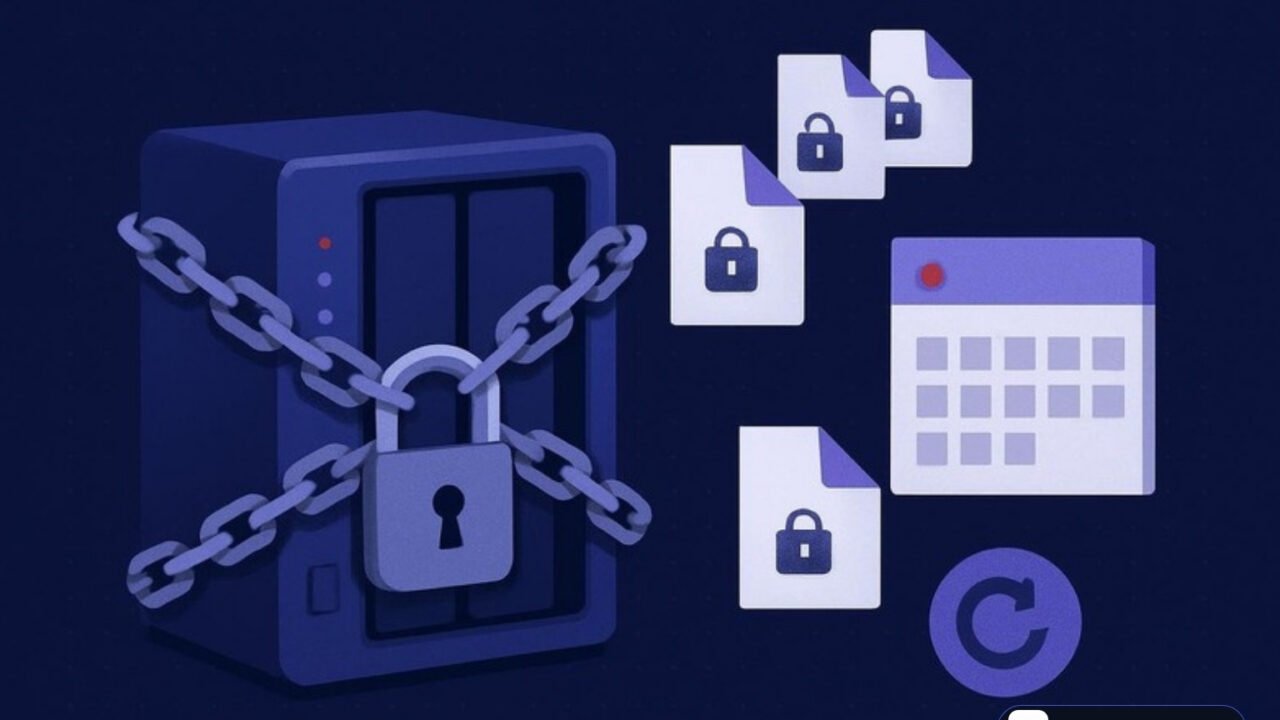
Threat card
- Status
- Actively exploited
- Threat type
- Ransomware
- Disclosed
- Oct 29, 2026
- Affected
- Synology NAS on DSM 7.2.2, 7.2.1, 7.2, 7.1 and 6.2 below the SA-24:20 fixed builds; SA-26-13 flaws also reportedly used
The short version
- Synology confirmed on 29 October 2026 that attackers are exploiting a DSM flaw patched in December 2024 to encrypt outdated NAS devices.
- Victims report the C3RB3R ransomware, which renames files with a .L0CK3D extension and drops read-me3.txt notes.
- Qihoo 360 says C3RB3R also exploits two CVSS 9.8 DSM flaws that Synology fixed in September 2026.
- No IOCs beyond host artefacts, no attribution and no data theft have been published so far.
Synology NAS ransomware attacks are hitting owners who never updated DiskStation Manager. On 29 October 2026 Synology confirmed that attackers are exploiting a vulnerability it fixed in December 2024 to encrypt data on devices still running outdated DSM builds, and it told every affected customer to update immediately. Victims report the C3RB3R ransomware renaming files with a .L0CK3D extension. If you run a Synology box that is exposed to the internet, confirm today that it is on a fixed DSM build and turn on automatic updates.
What happened
Synology says threat actors are exploiting a DSM vulnerability patched in December 2024 against NAS devices on outdated firmware, with the goal of encrypting stored data and demanding a ransom. The company did not name the exact CVE, but it pointed customers to its advisory Synology-SA-24:20.
The warning came in a short Synology statement urging users to update DSM, dated 29 October 2026 from Taipei. The Hacker News reported on 3 November that customers have posted infections publicly, and that the encryptor in these cases is C3RB3R. The statement itself does not name the ransomware family, the file extension or the ransom note, so those details come from victim reports and third-party analysis.
A second thread matters for defenders. According to Qihoo 360 Internet Security Center, as cited by The Hacker News, C3RB3R has a long history of going after NAS devices and reportedly exploits two DSM flaws that Synology fixed in September 2026. That means devices patched for the 2024 bugs but not for the 2026 ones may still be exposed.
Timeline
| Date | Event |
|---|---|
| November 2024 | Synology publishes advisory SA-24:20 covering CVE-2024-10441, CVE-2024-50629 and CVE-2024-10445 in DSM. |
| December 2024 | Synology states the vulnerability now being exploited was patched. |
| September 2026 | Synology advisory SA-26-13 fixes CVE-2026-13684 and CVE-2026-13639 (both CVSS 9.8). |
| 29 October 2026 | Synology issues a public statement urging all users on vulnerable DSM versions to update immediately. |
| By 3 November 2026 | NAS owners publicly report C3RB3R infections, .L0CK3D file extensions and read-me3.txt ransom notes on Reddit. |
| 3 November 2026 | The Hacker News reports the campaign, citing Qihoo 360 analysis that links C3RB3R to the 2026 DSM flaws. |
How the attack works
Public detail on the intrusion chain is limited. Synology has confirmed the access vector class (exploitation of a known DSM flaw on unpatched devices) and the impact (encryption for extortion). It has not published logs, exploit traffic or post-exploitation tooling.
Initial access
The attackers exploit DSM vulnerabilities on internet-reachable devices. The most severe bug in SA-24:20 is CVE-2024-10441 (CVSS 9.8), an improper encoding or escaping of output flaw in the system plugin daemon that can lead to remote code execution. The same advisory lists CVE-2024-50629 (CVSS 5.3), an output encoding flaw in the webapi component that allows reading limited files, and CVE-2024-10445 (CVSS 4.3), improper certificate validation in the update function that allows writing limited files. Synology has not said which of these is being used.
Qihoo 360 says C3RB3R also uses two flaws from SA-26-13: CVE-2026-13684, an output encoding flaw in SCGI that permits arbitrary file read and write and denial of service, and CVE-2026-13639, an insufficient entropy weakness in the login logic with the same impact. Both carry a CVSS score of 9.8.
Discovery and impact
Once running, the ransomware scans the device. Per the reporting, it skips 27 directories and certain executable and system file extensions so the NAS keeps working while user data is encrypted. Encrypted files receive the .L0CK3D extension, and a note named read-me3.txt is dropped into every affected directory.
What is not yet known
No source has published persistence mechanisms, credential theft, data exfiltration before encryption, ransom amounts or payment infrastructure for this wave. Treat any claim of data theft as unconfirmed until a primary source reports it.
MITRE ATT&CK mapping
| Tactic | Technique (ID) | How it was used here |
|---|---|---|
| Initial Access | Exploit Public-Facing Application (T1190) | Exploitation of patched DSM vulnerabilities on outdated, internet-reachable NAS devices. |
| Discovery | File and Directory Discovery (T1083) | The encryptor scans the device and excludes 27 directories and system file types. |
| Impact | Data Encrypted for Impact (T1486) | User files are encrypted, renamed to .L0CK3D and a ransom note is left behind. |
Who is behind it
The operators are not yet attributed. Synology does not name a group, and the only family name in circulation, C3RB3R, comes from victim reports and Qihoo 360 analysis. No source has tied the activity to a known affiliate program or a nation-state.
The pattern is familiar. In 2019 QNAP devices were hit by QNAPCrypt, also known as eCh0raix. In August 2021 Synology warned of brute-force attacks by a botnet using StealthWorker malware that led to ransomware, and the same month Palo Alto Networks Unit 42 described an eCh0raix variant hitting both QNAP and Synology devices through CVE-2021-28799 or weak admin credentials. NAS ransomware remains a durable, low-effort business for criminals.
Affected products and versions
Any Synology NAS running DSM below the fixed builds listed in SA-24:20 is in scope. Owners should also apply the September 2026 SA-26-13 fixes, given the Qihoo 360 findings.
| Product | Affected | Fixed | CVE | CVSS |
|---|---|---|---|---|
| DSM 7.2.2 | Below 7.2.2-72806-1 | 7.2.2-72806-1 or later | CVE-2024-10441, CVE-2024-50629, CVE-2024-10445 | 9.8 / 5.3 / 4.3 |
| DSM 7.2.1 | Below 7.2.1-69057-6 | 7.2.1-69057-6 or later | SA-24:20 set | Up to 9.8 |
| DSM 7.2 | Below 7.2-64570-4 | 7.2-64570-4 or later | SA-24:20 set | Up to 9.8 |
| DSM 7.1 | Below 7.1.1-42962-7 | 7.1.1-42962-7 or later | SA-24:20 set | Up to 9.8 |
| DSM 6.2 | Below 6.2.4-25556-8 | 6.2.4-25556-8 or later | SA-24:20 set | Up to 9.8 |
| DSM (per SA-26-13) | See advisory | See Synology-SA-26:13 | CVE-2026-13684, CVE-2026-13639 | 9.8 / 9.8 |
Indicators of compromise
No network indicators or hashes have been published by Synology or the researchers cited. The host artefacts below come from victim reports.
| Type | Indicator | Context |
|---|---|---|
| File extension | .L0CK3D |
Appended to encrypted files |
| File name | read-me3.txt |
Ransom note dropped in each affected directory |
| Malware family | C3RB3R | Encryptor named in victim reports and Qihoo 360 analysis |
Detection and hunting
Start with exposure. List every Synology device reachable from the internet, including DSM web ports and any QuickConnect or reverse proxy publishing, and record its exact DSM build. Anything below the fixed builds above should be treated as potentially compromised, not just vulnerable.
On each device, search shared folders for files ending in .L0CK3D and for any read-me3.txt file. Review DSM Log Center for unexpected administrator logins, new accounts, package installs and configuration changes around late October 2026. If you forward NAS logs to a SIEM, alert on bursts of file rename events across many shares in a short window, which is the clearest behavioural signal of encryption in progress.
At the network edge, look for inbound requests to DSM management interfaces from unfamiliar IP ranges and for spikes in failed logins, which were the precursor in the 2021 StealthWorker wave. No Sigma or YARA rules specific to C3RB3R have been published by the sources cited here.
Mitigation and response
- Update DSM now to the fixed build for your branch, then apply the SA-26-13 updates. Enable automatic updates, as Synology recommends.
- Remove DSM management interfaces from direct internet exposure. Put remote access behind a VPN with multi-factor authentication.
- If any
.L0CK3Dfiles orread-me3.txtnotes are found, disconnect the device from the network, preserve logs and do not reboot until evidence is captured. - Restore from offline or immutable snapshots that predate the infection. Verify that Btrfs snapshots and Hyper Backup targets were not themselves encrypted.
- Rotate every credential stored on or used to reach the NAS, including admin accounts, SMB users and any cloud sync tokens.
- Monitor for re-infection after restoration, since an unpatched device will be re-exploited.
For a related case where attackers moved within days of disclosure, see our brief on the chained Ivanti Connect Secure zero-days.
Analyst take
This is a patch-hygiene failure, not a novel attack. The headline bug was fixed nearly two years ago, and Synology still has to publish a warning because a large population of consumer and small-business NAS devices never update. Those devices sit outside most corporate asset inventories, yet they often hold backups, finance shares and design files, which is exactly what makes them worth encrypting.
The Qihoo 360 claim that C3RB3R also uses September 2026 flaws is the part to watch. If it holds, the crew is tracking new DSM advisories and weaponising them quickly, so “patched in 2024” is no longer a safe state. Small firms, MSP clients and home offices that rely on a single NAS as both primary storage and backup carry the most risk. Treat the NAS as a server, patch it on a schedule and keep at least one copy of your data where the NAS cannot reach it. Our earlier brief on mass exploitation of the Langflow MCP flaw shows the same speed from advisory to attack.
What to do now
0 of 5 done
Questions readers ask
Which ransomware is attacking Synology NAS devices?
Victims report C3RB3R, which encrypts files with a .L0CK3D extension and leaves a read-me3.txt ransom note. Synology itself has not named the family.
Which DSM versions are safe?
DSM 7.2.2-72806-1, 7.2.1-69057-6, 7.2-64570-4, 7.1.1-42962-7, 6.2.4-25556-8 or later fix the SA-24:20 flaws. Also apply the September 2026 SA-26-13 updates.
What should I do if my Synology NAS is encrypted?
Disconnect it from the network, preserve logs, restore from offline backups and rotate every credential before reconnecting a fully updated device.
Sources
- Synology: Synology urges users to update DSM following ransomware attacks on outdated DSM versionssynology.com
- Synology: Security Advisory Synology-SA-24:20synology.com
- Synology: Security Advisory Synology-SA-26:13synology.com
- The Hacker News: Synology NAS Devices Targeted in Ransomware Attacks Exploiting Patched DSM Flawthehackernews.com
- Palo Alto Networks Unit 42: eCh0raix ransomware targets SOHO NAS devicesunit42.paloaltonetworks.com
One short email when something serious breaks.
Threatspedia covers major cyber threats only, verified against primary sources. Read our editorial policy, or report a correction.